Luckydreams Casino in Review: What Actually Stands Out for NZ Players
An educational look at Luckydreams: bonuses, wagering, games and what New Zealand's changing rules mean for offshore play.
Last updated: 13 July 2026
Luckydreams Casino is an offshore online gaming platform that has attracted a following among Kiwi players searching for a broad pokies library, regular promotions and fast digital payment options. Like the majority of online casinos accessed from New Zealand today, Luckydreams operates without any New Zealand licence, because no such licence yet exists — the country's first regulated online casino regime, established under the Online Casino Gambling Act 2026, does not begin issuing operator licences until 1 December 2026.
This guide takes an educational approach to Luckydreams Casino, explaining how the platform positions itself, what its bonus terms typically involve, how its games and payment systems work, and — critically — what New Zealand's changing regulatory landscape means for anyone using an offshore site in the meantime. The aim is to help Kiwi readers make informed, safer decisions rather than to promote any particular operator.
Casino Overview
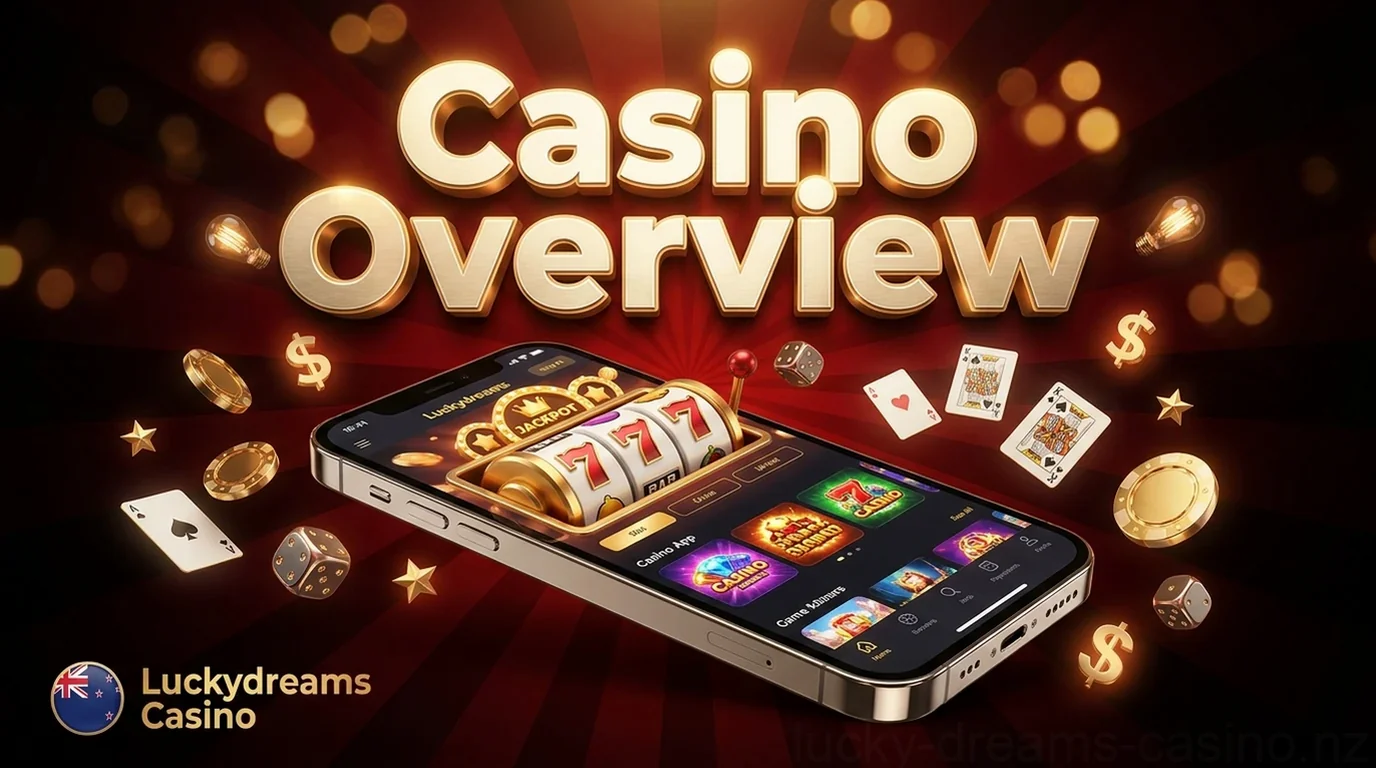
Luckydreams Casino presents itself as a broad-spectrum online gaming platform, offering pokies alongside table games, live dealer options and, in some markets, virtual sports. The site's layout follows a familiar pattern for offshore operators: a searchable game lobby, category filters by provider or game type, and a promotions tab summarising current offers.
For New Zealand visitors specifically, the platform is accessed in NZD in some cases, though pricing and currency display can vary and should be confirmed directly on the account registration page rather than assumed. As with any offshore operator, Kiwi players should treat the "About" and terms pages as the authoritative source for jurisdictional availability, since this can change without notice.
What a New Zealand Player Should Check Before Registering
Before creating an account at Luckydreams or any similar platform, a short due-diligence pass can help avoid unpleasant surprises later, particularly around withdrawals and identity verification.
- Confirm which foreign licence the operator holds and where this is disclosed (usually in the site footer).
- Check whether NZD is supported natively or whether conversion fees apply.
- Read the withdrawal section of the terms for processing times and maximum monthly limits.
- Look for mention of independent testing of games (RNG/RTP certification).
- Review the account verification (KYC) requirements before depositing significant funds.
None of these checks guarantee a smooth experience, but they build a realistic picture of how the operator functions before money changes hands.
Bonuses at Luckydreams

Bonus offers are one of the first things Kiwi players notice when researching an online operator, and Luckydreams is no exception. Like most offshore platforms, it typically structures its promotions around a welcome package for new depositors, followed by recurring offers such as reload bonuses, free spins on selected pokies, or loyalty-based rewards for regular players. These offers are marketing tools designed to encourage sign-up and continued play, so understanding the mechanics behind them matters more than the headline figure.
A welcome bonus at an operator like Luckydreams is generally presented as a percentage match on a first deposit, sometimes combined with a batch of free spins on a featured pokie title. The advertised number — for example a match up to a certain amount — is only part of the picture; the real value (or cost) of the offer sits in the wagering requirements, maximum bet limits, and game contribution rates attached to it, all covered in more detail below.
Typical Promotion Types
Offshore casinos generally rotate a similar set of promotional formats, and Luckydreams' offer structure tends to reflect this industry pattern rather than anything unique to the brand.
Welcome Match
Welcome deposit match bonus, often tiered across the first few deposits.
Free Spins
Free spins packages tied to specific pokies providers or new game releases.
Reload
Reload bonuses offered on selected days of the week.
Cashback
Cashback promotions returning a percentage of net losses over a period.
VIP / Loyalty
VIP or loyalty schemes rewarding consistent play with perks such as faster withdrawals.
| Bonus type | Typical structure | What to check |
|---|---|---|
| Welcome match | Percentage of first deposit, capped amount | Wagering multiple, expiry window |
| Free spins | Fixed number on a nominated pokie | Winnings cap, contribution rate |
| Reload bonus | Smaller match on subsequent deposits | Frequency limits, minimum deposit |
| Cashback | Percentage of losses returned | Whether it's cash or bonus funds |
Before opting into any promotion at Luckydreams or a comparable site, it is worth reading the full bonus terms rather than relying on the promotional banner. Red flags to watch for include unusually high wagering multiples (above 40x), very short expiry periods, and maximum win caps that are not clearly disclosed upfront.
Wagering Explained

Wagering requirements are the mechanism that determines how much betting activity is needed before bonus funds, or winnings derived from them, become withdrawable. This is arguably the most misunderstood part of any casino bonus, and it applies at Luckydreams in much the same way it does across the offshore industry.
In practical terms, a wagering requirement is expressed as a multiplier — for instance 30x or 40x — applied either to the bonus amount alone or to the combined bonus-plus-deposit total. A NZ$50 bonus with a 30x wagering requirement on the bonus amount means a player must place NZ$1,500 in total bets before any related winnings can be withdrawn. The multiplier compounds quickly, so understanding it is essential before accepting an offer.
How Game Contribution Affects Wagering
Not all games count equally toward clearing a wagering requirement. Pokies typically contribute 100%, whereas table games such as blackjack or roulette often contribute a much smaller percentage, sometimes as little as 10-20%, because of their comparatively lower house edge.
- Pokies (video slots): usually 100% contribution.
- Live dealer games: often reduced, commonly 10-25%.
- Table games (blackjack, baccarat): frequently low, around 5-20%.
- Progressive jackpot pokies: sometimes excluded entirely from bonus play.
A further point Kiwi players should note is the maximum bet rule that applies while a bonus is active. Most operators, including offshore sites like Luckydreams, cap the stake per spin during wagering — commonly around NZ$5 or NZ$10 — and breaching that cap can void the bonus and any associated winnings. This clause is frequently buried in the general terms and conditions, so it is worth checking before increasing bet sizes.
Luckydreams Casino's player favourites
Luckydreams Casino features a diverse selection of popular slots, including high-RTP titles like Hellcatraz (96.43%) and Gonzo's Quest (95.97%), alongside volatile adventure games like Book of Shadows. Each game offers distinct mechanics and themes to suit different player preferences.











































Software providers we work with
The casino partners with certified game developers including Pragmatic Play, NetEnt, and Nolimit City. All titles are tested by independent auditors and operate under strict RNG certification to ensure fair and transparent gameplay.
Game Library
The core appeal of an offshore platform like Luckydreams for most Kiwi players is the sheer size and variety of its pokies library, generally sourced from multiple third-party software studios rather than developed in-house. This multi-provider model is standard across the offshore casino industry and allows operators to offer thousands of titles without producing the games themselves.
Pokies form the largest category, typically spanning classic three-reel formats, modern video pokies with elaborate bonus features, and branded titles licensed from popular media franchises. Beyond pokies, most platforms of this type also carry a table games section (blackjack, roulette, baccarat variants), a live dealer studio streamed from a real or virtual studio, and occasionally niche categories like scratch cards or virtual game shows.
Common Software Providers
Offshore casinos generally aggregate content from an array of established studios, each known for particular strengths — some for high-volatility pokies, others for live dealer production quality.
| Provider | Known for | Typical RTP range |
|---|---|---|
| Pragmatic Play | High-volatility video pokies, live tables | ~96% |
| NetEnt | Branded and classic pokies | ~96% |
| Play'n GO | Adventure-themed pokies | ~96% |
| Evolution | Live dealer games | Game-dependent |
| Microgaming | Progressive jackpot pokies | Varies by title |
Return to Player (RTP) figures are theoretical percentages calculated over millions of spins and certified through independent testing labs such as iTech Labs or eCOGRA. An individual session's outcome can differ substantially from the long-run RTP figure, and no certification changes the fact that outcomes are randomised and unpredictable session to session.
How Casino Game Mechanics Work
Understanding the mechanics behind online pokies and table games helps put both wins and losses into perspective, and this knowledge applies whether a player is at Luckydreams or any other regulated software provider's game. Every certified pokie runs on a Random Number Generator (RNG), a piece of software that continuously produces unpredictable sequences of numbers, each corresponding to a specific game outcome. Because the RNG operates independently of previous spins, there is no mechanical "pattern" to detect, and no strategy can influence which outcome the RNG produces next.
RTP (Return to Player) is a separate but related concept: it is the theoretical percentage of all wagered money a game is designed to pay back to players over a very large number of spins, typically millions. An RTP of 96%, for example, means that over the long run the game is designed to return NZ$96 for every NZ$100 wagered — but this is a statistical average, not a promise for any individual session, which can swing well above or below that figure.
Volatility (sometimes called variance) describes how a game pays out over time, independent of RTP. A low-volatility pokie tends to deliver smaller, more frequent wins, while a high-volatility pokie pays less often but with potentially larger amounts when it does. Recognising volatility helps players choose games that suit their bankroll and risk tolerance rather than expecting any format to guarantee particular outcomes.
- RNG: generates unpredictable outcomes independently for every spin or hand.
- RTP: theoretical long-term payback percentage, verified through independent audits.
- Volatility: frequency and size of wins, unrelated to fairness.
- House edge: the mathematical advantage built into every casino game, ensuring the operator is profitable over time regardless of individual results.
Reputable software providers submit their RNGs and RTP calculations for independent certification by testing bodies such as iTech Labs or eCOGRA, which audit the software for statistical fairness. This certification process is a meaningful trust signal, but it verifies the mathematics of the game — it does not eliminate the inherent risk of gambling or guarantee any individual result.
Banking
Payment flexibility is a practical concern for many New Zealand players, particularly as some Kiwi banks apply additional scrutiny or restrictions to transactions flagged as gambling-related. Offshore platforms like Luckydreams typically respond to this by offering a broad mix of payment rails, including e-wallets and cryptocurrency, which can process independently of a NZ bank's own gambling transaction rules.
Typical Payment Methods
While exact availability depends on account region and ongoing provider agreements, offshore casinos serving New Zealand commonly support a combination of the following payment types.
| Method | Typical speed | Notes for NZ players |
|---|---|---|
| Visa/Mastercard | Instant deposit; withdrawal 2-5 days | Some NZ banks flag or decline gambling transactions |
| e-Wallets (e.g. Skrill, Neteller) | Instant deposit; withdrawal within 24 hrs | Useful when card deposits are blocked |
| Cryptocurrency (BTC, ETH, USDT) | Near-instant to a few hours | No bank intermediary; volatility risk applies |
| Bank transfer | 1-3 business days | Slower but widely accepted |
Cryptocurrency deposits and withdrawals have become increasingly relevant for New Zealand players because they bypass the domestic banking system entirely, sidestepping the card declines some Kiwi banks apply to overseas gambling merchants. However, crypto carries its own considerations: price volatility between deposit and withdrawal, the irreversibility of blockchain transactions, and the need to use the correct wallet address and network every time.
Before depositing at Luckydreams or a comparable platform, it is worth confirming the following practical points, since banking issues are among the most common sources of player frustration with offshore sites.
- Minimum and maximum deposit/withdrawal limits per method.
- Whether identity verification (KYC) must be completed before the first withdrawal.
- Any currency conversion fees if NZD is not natively supported.
- Processing timeframes, which are usually longer for card withdrawals than for e-wallets or crypto.
Licensing & Safety
Licensing is the area where New Zealand players most need clear, accurate information, because the regulatory landscape is actively changing. As of the time of writing, no online casino operator — including Luckydreams — holds a New Zealand licence , because New Zealand has not yet issued any. The Online Casino Gambling Act 2026, administered by the Department of Internal Affairs (DIA / Te Tari Taiwhenua), comes into force on 1 May 2026 and establishes the country's first-ever licensing regime for online casino gaming. Under this Act, up to 15 operator licences will be allocated during 2026, with licences issued from 1 December 2026 and the full regime expected to be operational during 2027.
Until that regime is fully active, New Zealand-based players who use platforms such as Luckydreams are using an offshore operator. Offshore operators typically hold a licence from a foreign authority — common examples include the Malta Gaming Authority (MGA), the Government of Curaçao, or the Kahnawake Gaming Commission. It is important to state plainly: a Curaçao, MGA or Kahnawake licence is a foreign authorisation only — it is not a New Zealand licence, and it does not mean the operator is licensed or regulated in New Zealand. These bodies impose their own standards on operators, but New Zealand consumer protection law and DIA oversight do not currently extend to them.
What Foreign Licensing Typically Covers
Foreign gambling licences generally require operators to meet baseline standards, though the rigour varies considerably between authorities.
- Segregation of player funds from operational funds.
- Independent RNG and RTP testing through labs such as eCOGRA or iTech Labs.
- SSL/TLS encryption for data transmitted between player and platform.
- Defined dispute resolution or complaints procedures (quality varies by authority).
- Anti-money-laundering (AML) and identity verification (KYC) obligations.
The important legal point for Kiwi readers is this: it is not a criminal offence for an individual New Zealander to play at an offshore online casino — the Act targets unlicensed operators and their advertising in New Zealand, not individual players. However, playing offshore means forgoing New Zealand consumer protections, DIA oversight, and any local avenue for dispute resolution if something goes wrong. There is currently no New Zealand regulator to appeal to if an offshore operator delays a withdrawal or closes an account, which is a materially different risk position from what will exist once DIA-licensed platforms launch from December 2026 onward.
Until DIA-licensed operators are live, no online casino can accurately be described as "licensed in New Zealand," "legal in New Zealand," or "regulated by the DIA." Any such claim about an operator, including Luckydreams, would be inaccurate at the time of writing.
How to Start
Create Account
Register and confirm which foreign licence and currency (NZD) the operator supports.
Verification
Complete the account verification (KYC) requirements before depositing significant funds.
First Deposit
Fund via card, e-wallet or cryptocurrency, checking minimum and maximum limits.
Play & Win
Read the full bonus terms and wagering rules before opting into any promotion.
Pros & Cons
Pros
- Broad pokies library from established software providers
- Familiar bonus structure with standard wagering conditions
- e-Wallets and cryptocurrency alongside traditional cards
- Crypto bypasses NZ bank gambling-transaction declines
- Games sourced from independently-tested studios (RNG/RTP certified)
Cons
- Holds no New Zealand licence — offshore operator only
- No NZ consumer protections or DIA oversight currently apply
- No local dispute resolution avenue if a withdrawal is delayed
- Crypto carries price volatility and irreversibility risk
Responsible Gambling
Responsible gambling practices matter regardless of which platform a player chooses, and they take on particular importance while New Zealand's licensing framework is still being rolled out and offshore sites remain the only practical option for online casino play. Online casino gaming in New Zealand is restricted to adults aged 18 and over ; this age threshold applies specifically to online play (the higher age of 20 applies only to entry onto a physical, land-based casino floor).
If gambling stops being enjoyable or starts to feel out of control, free and confidential support is available every day of the week through the national Gambling Helpline on 0800 654 655 , or by texting 8006 . The Ministry of Health-backed resource safergambling.org.nz also provides information, self-assessment tools and links to local support services. In a genuine crisis or emergency situation, call 111 immediately.
Managing Play at an Offshore Operator
Because Luckydreams and comparable platforms operate offshore, New Zealand does not yet have a live national self-exclusion register that can block access to them — such a register is mandated under the new regime by December 2027 but is not yet operational. In the meantime, players wanting to limit or stop their play need to rely on tools offered directly by the operator, supplemented by independent software where needed.
- Use the casino's own account settings to set deposit limits, loss limits, or session time reminders.
- Request a temporary "cooling off" period or full self-exclusion directly through the operator's support channel.
- Close the account entirely if self-exclusion tools are insufficient.
- Install independent blocking software such as Gamban or GamBlock, which can restrict access to gambling sites across devices regardless of which operator is used.
- Keep a record of deposit and loss patterns to recognise early warning signs of harmful play.
These tools are not a substitute for professional support if gambling is causing financial, relationship or mental health harm, but they are practical, immediately available steps that any Kiwi player can take today, independent of when New Zealand's own licensed platforms and self-exclusion register become fully operational.
FAQ
Is Luckydreams Casino licensed in New Zealand?
No. No online casino currently holds a New Zealand licence, because DIA licences under the Online Casino Gambling Act 2026 are only issued from 1 December 2026. Luckydreams operates under a foreign licence, which is not a New Zealand authorisation.
Is it illegal for me to play at Luckydreams from New Zealand?
Playing as an individual is not a criminal offence under New Zealand law; the Act targets unlicensed operators and advertisers, not players. However, offshore play carries no New Zealand consumer protections or DIA oversight.
What is the minimum age to play online casino games in New Zealand?
18 years old for online casino play. The higher threshold of 20 applies only to physical casino venues, not online platforms.
Do I pay tax on winnings from Luckydreams?
Recreational gambling winnings are generally not taxed in New Zealand for individual players.
Can I use cryptocurrency at Luckydreams?
Many offshore operators, including platforms like Luckydreams, support cryptocurrency deposits and withdrawals, which can be useful when NZ bank cards decline gambling-related transactions. Availability should be confirmed directly on the site.
What happens when New Zealand's DIA-licensed casinos launch?
From 1 December 2026, licensed operators will begin appearing under DIA oversight, offering New Zealand-specific consumer protections that offshore sites currently cannot provide.
How long do withdrawals take at Luckydreams?
Processing timeframes vary by method: card withdrawals typically take 2-5 days, e-Wallets within 24 hrs, and cryptocurrency near-instant to a few hours. Card withdrawals are usually longer than e-wallets or crypto.
What wagering requirements should I watch for?
Wagering is expressed as a multiplier such as 30x or 40x. A NZ$50 bonus with a 30x requirement on the bonus amount means placing NZ$1,500 in total bets before related winnings can be withdrawn. Red flags include multiples above 40x, very short expiry periods and undisclosed maximum win caps.
Final Verdict
Luckydreams Casino reflects a typical offshore online casino experience available to New Zealand players today: a broad pokies library sourced from established software providers, a familiar bonus structure with standard wagering conditions, and payment options that include e-wallets and cryptocurrency alongside traditional cards. None of this is unusual within the current offshore market, and none of it should be mistaken for New Zealand licensing or regulatory endorsement.
For Kiwi readers, the most important takeaway is contextual: New Zealand is in a genuine transition period. The Online Casino Gambling Act 2026 will bring the country's first DIA-licensed online casinos into operation from December 2026, offering local consumer protections that no offshore platform — Luckydreams included — currently provides. Until then, anyone choosing to play offshore should do so with a clear understanding of foreign licensing limitations, verified banking practices, and responsible gambling tools, treating this guide as a starting point for further independent research rather than a recommendation to play.